Best 7 carbon accounting software for logistics (2026)

Are you looking to measure your CO2 emissions? Read our list of the top 7 carbon accounting software for logistics or transport companies.

{{highlight-text}}
Last updated: August 2026
What is carbon accounting software?
Carbon accounting software is used to calculate, analyze, and report on CO2 emissions of a company’s operations. This helps companies to accurately report on their carbon emissions, take action to reduce their footprint, offer more sustainable options to their clients, and comply with regulations like the CSRD.
Companies in the logistics and transport sector need to take carbon accounting extra seriously, as this sector is responsible for over 33% of global CO2 emissions. Carbon accounting software helps these companies with the difficult task of calculating emissions for individual shipments and transport legs, and transparently sharing this data with their clients.
It also helps logistics and transport companies to measure and report on their emissions so that they can implement carbon reduction initiatives and comply with relevant legislation.
Top 7 carbon accounting software for logistics and transport companies in 2026
Without further ado, we’ll give you an overview of these 7 carbon accounting software options for the logistics and transport industry.
1. BigMile
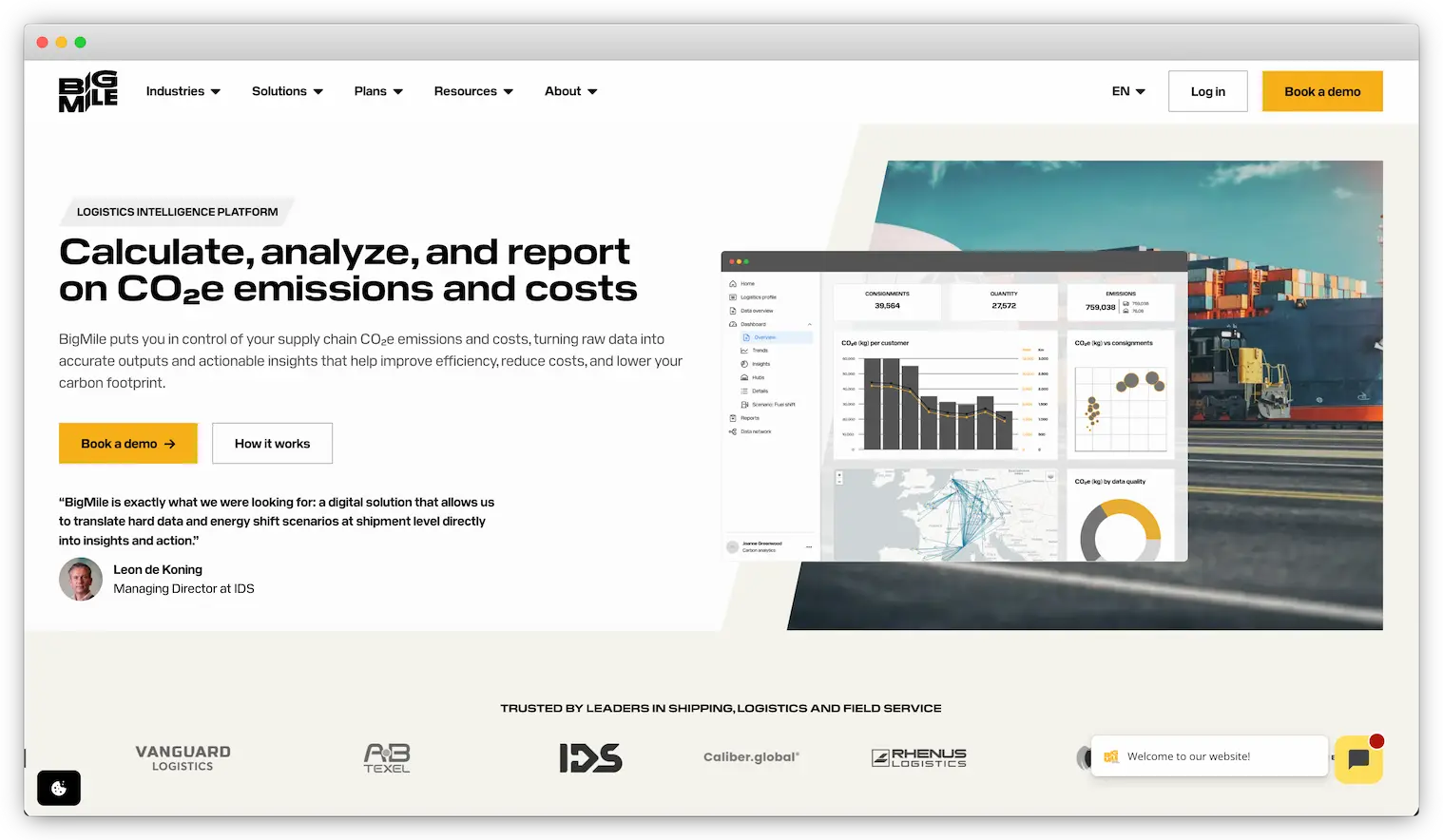
BigMile provides carbon accounting software designed to help logistics and transport companies easily calculate and report on multi-modal, supply chain-related CO₂e emissions. The emissions calculation methodology complies with standards like ISO 14083 and the GLEC Framework to ensure accurate emissions calculations.
With the BigMile platform, companies can gain enhanced visibility of emissions across their supply chains, outperform their customers’ expectations with custom reports on a per shipment level, take action to reduce emissions, and comply with voluntary and mandatory sustainability regulations.
The platform’s advanced analytics capabilities provide users with insights into their historical emissions data and help identify ways to reduce emissions through scenario planning. This means that BigMile’s logistics and transport clients can easily identify lower-emission transport routes and offer these to their customers, helping to reduce overall transport emissions and keeping customers happy—a win-win scenario.
Many large logistics service providers (LSPs) are already using BigMile to improve the accuracy of their emissions reporting and reduce their carbon footprint, including De Rijke Group.
Martijn Scheffers explains how BigMile helped De Rijke Group become a leader in sustainability:
“We are among the top 3% worldwide in terms of sustainability assessments. And that's also because we have our CO2 management well in order now. So, where we initially stood at zero, we have quickly developed a very robust CO2 framework. We can now map everything out accurately thanks to BigMile’s platform.”
Website: https://www.bigmile.eu/
Highlights:
- Calculates multi-modal transport emissions in line with ISO 14083 and the GLEC Framework.
- Consolidates CO2 emissions data across entire supply chains for in-depth analysis
- Easy and accessible data import
- Interactive and customizable dashboard
- Provides ‘what-if’ scenario modeling options
- Supports CSRD compliance with automated reporting and tracking.
- Multiple partnerships with software providers like DeliveryMatch.
Best suited for: LSPs, carriers, and shippers who want an ISO 14083-compliant carbon accounting platform that can calculate shipment-level emissions and provide custom dashboards and reports.
2. Cozero
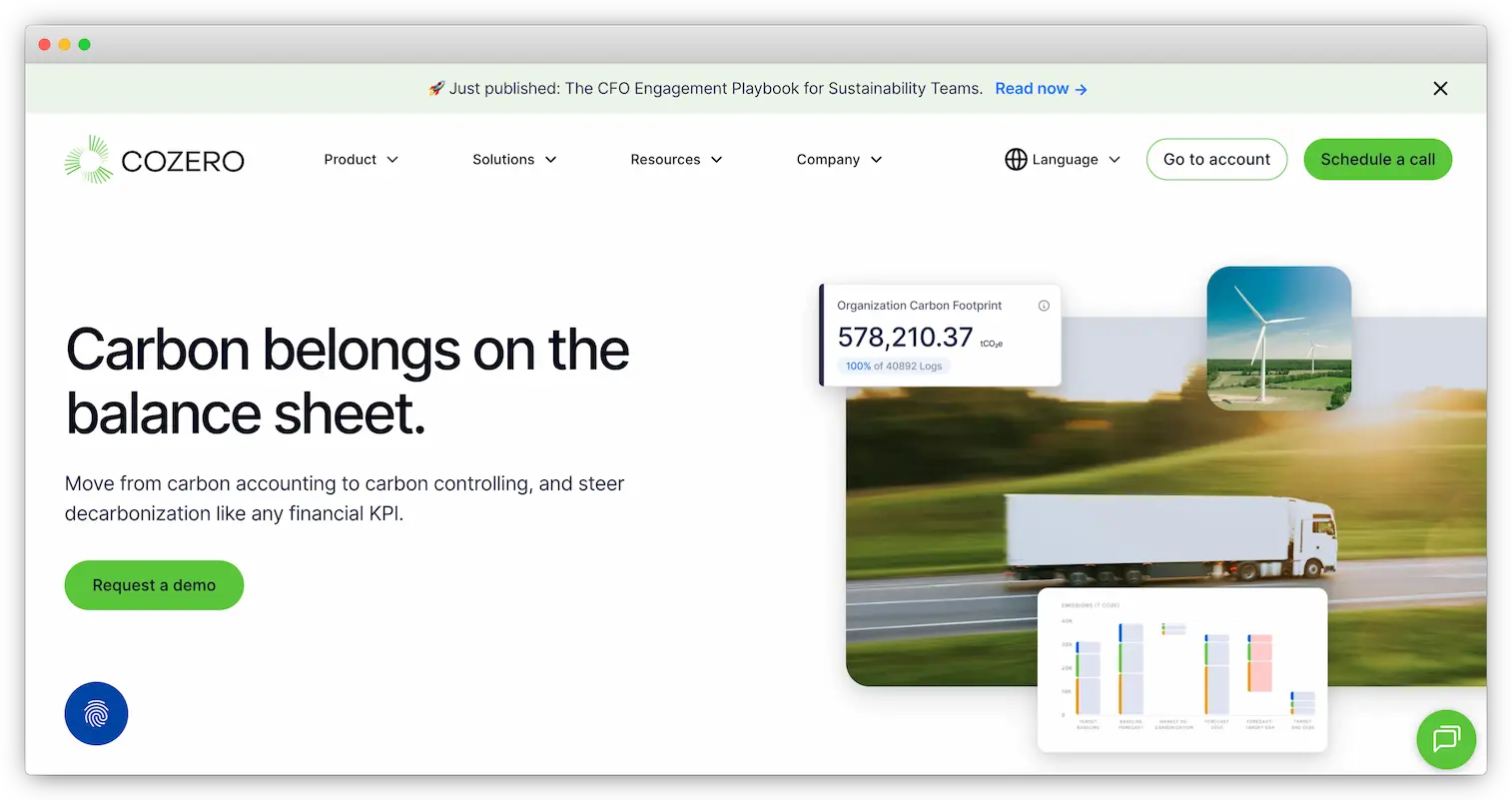
Founded in Berlin in 2020, Cozero is a carbon management platform designed for mid-to-large enterprises, with a specific focus on the logistics and manufacturing industries. Its Climate Action Platform covers the full carbon management cycle through three modules: Log (emissions data collection and calculation), Act (decarbonization planning and scenario modeling), and Share (reporting and stakeholder engagement).
Cozero provides detailed emissions calculations across all transport modes—road, air, sea, rail, and inland waterways—and integrates with EcoTransIT World to generate ISO 14083 and GLEC-compliant calculations for purchased logistics activities. This makes it well-suited for companies that need granular transport emissions data embedded within a broader Scope 1–3 carbon management platform.
Beyond emissions measurement, Cozero's Act module helps companies identify and prioritize decarbonization initiatives based on both climate impact and financial return, using its Return on Carbon Investment (ROCI) framework. Reporting outputs support compliance with CSRD, CDP, and SBTi requirements.
Website: https://www.cozero.io/
Highlights:
- Emissions calculation across all transport modes, aligned with ISO 14083 and GLEC Framework
- Direct integration with EcoTransIT World for granular purchased logistics emissions
- Covers full Scope 1–3 emissions across the entire value chain
- Scenario modeling and decarbonization planning with financial impact assessment
- Supports CSRD, CDP, and SBTi compliance reporting
Best suited for: Mid-to-large logistics companies that need an end-to-end carbon management platform that connects emissions measurement, decarbonization planning, and compliance reporting in a single system.
3. Loginex
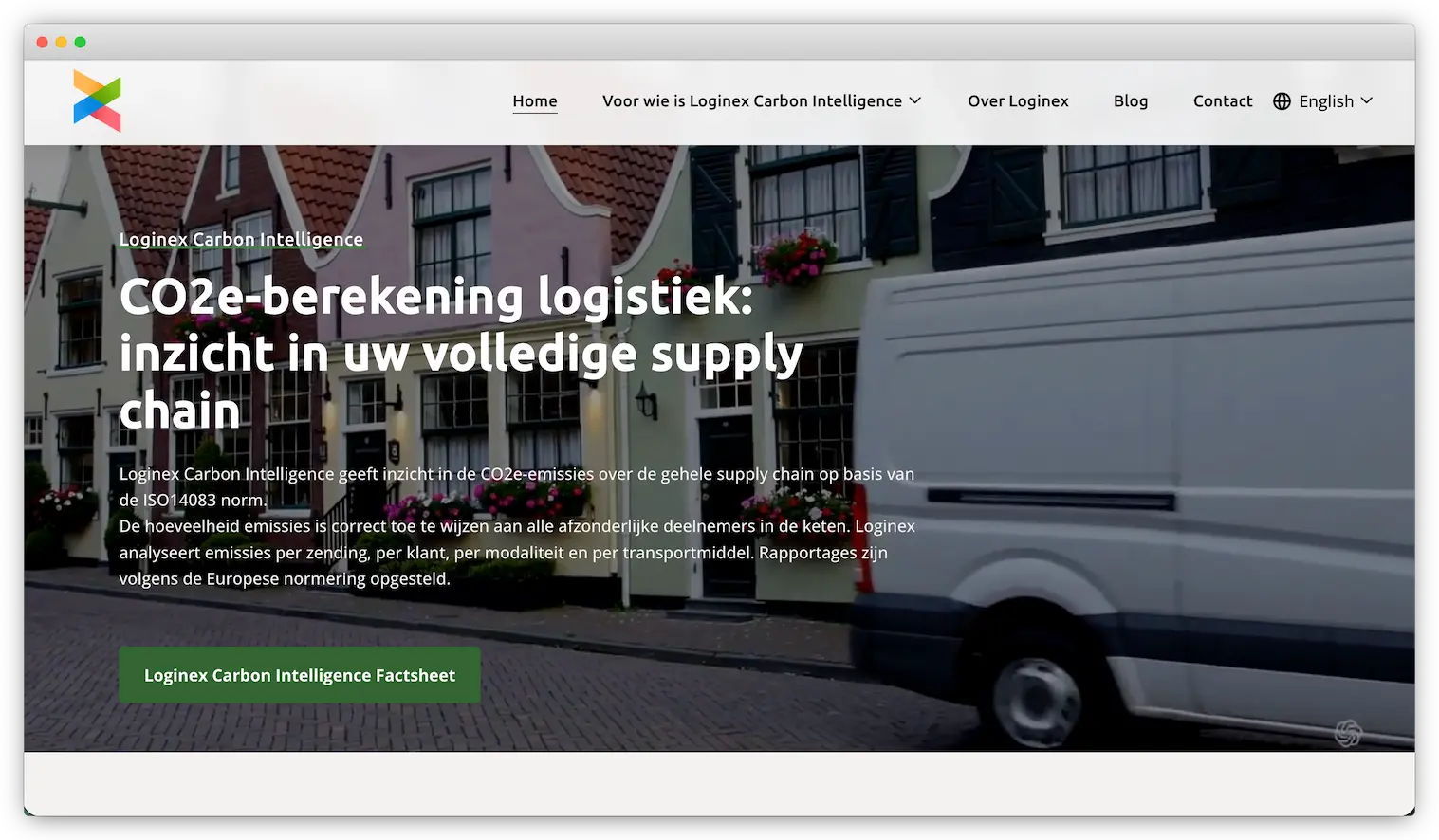
Loginex was originally formed to help logistics companies comply with EU emissions regulations. The platform uses multiple industry standards, including EN 16258, COFRET, ISO 14083, and the GLEC Framework, to calculate emissions per shipment, per customer, per mode of transport, and per vehicle.
Loginex integrates with logistics operations through a data-driven approach, allowing businesses to track emissions at a granular level. In addition to automated reporting, the platform provides tools for supply chain optimization and benchmarking, helping users reduce their carbon footprint.
Loginex is suitable for LSPs, carriers, shippers, and consultants who are primarily focused on complying with the latest European regulations, whereas companies looking for more insights on optimizing their transport options and scenario modeling may prefer an alternate solution.
Website: https://loginex.ai/
Highlights:
- Emissions measurement using the GLEC Framework, EN 16258, COFRET, and ISO 14083.
- Integration with logistics systems for automated emissions tracking.
- Supports CSRD compliance and supply chain sustainability reporting.
- Automated reporting and dashboards
Best suited for: Europe-based LSPs, carriers, shippers, and consultants that need a reliable, regulation-focused tool for emissions calculation and reporting.
4. Searoutes
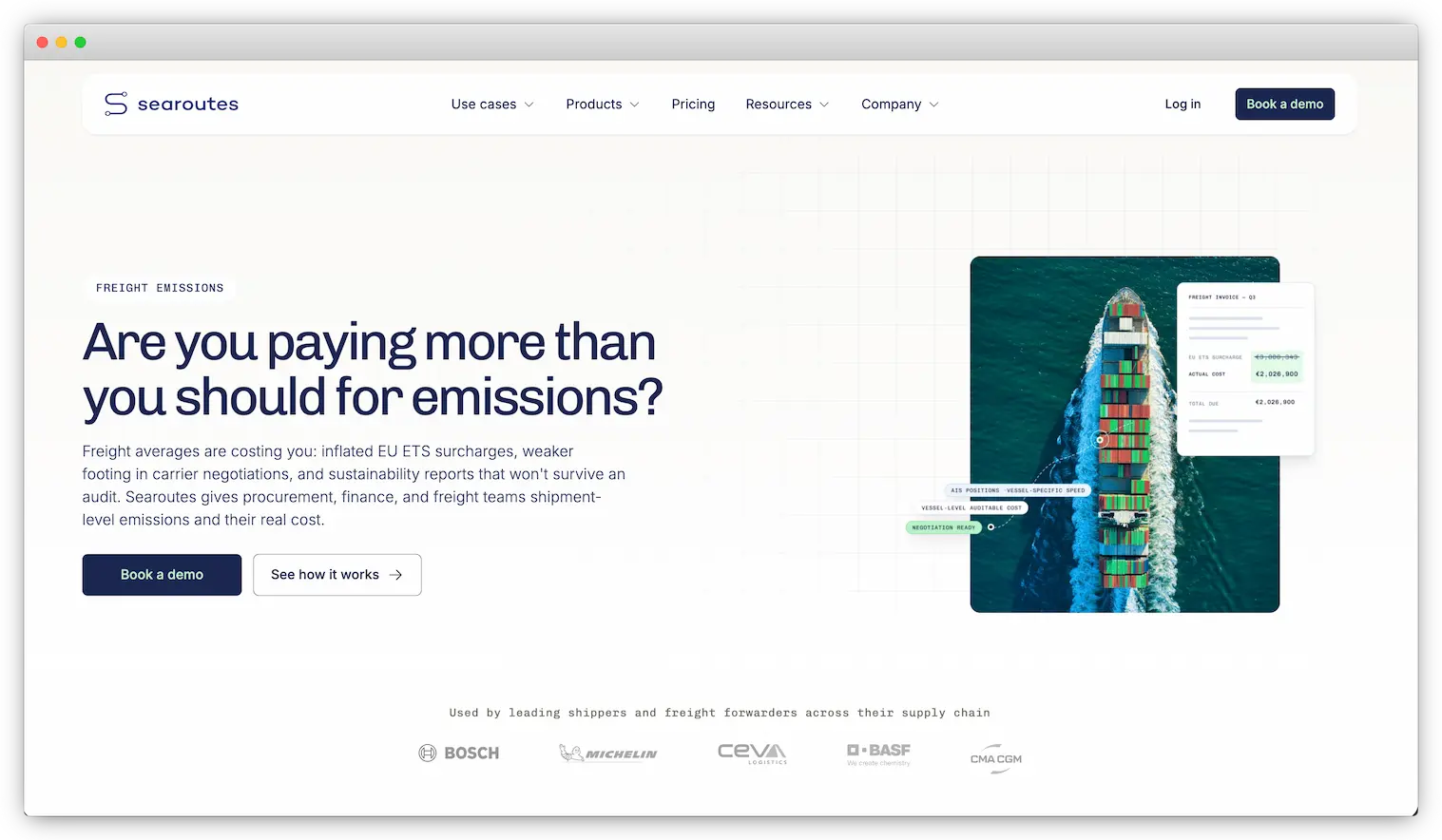
Based in Hamburg, Searoutes provides carbon accounting software designed for shippers, freight forwarders, and logistics providers. The platform focuses on emissions calculation and route optimization, using modern algorithms and datasets that go beyond standard methodologies like the GLEC Framework and ISO 14083.
Searoutes is an API-first platform that can be added to shippers, freight forwarders, and logistics providers’ existing systems, and allows them to compare transport modes and optimize shipments for lower emissions. It also offers live tracking of containers or vessels at sea through its vessels API.
Like the other solutions, it helps logistics and transport companies comply with CSRD and other sustainability regulations. However, it is better suited to companies who want a carbon emissions calculator in their own system (via an API) rather than companies who are looking for user-friendly software with detailed reporting and custom dashboards.
Website: https://searoutes.com/
Highlights:
- API-first solution that can be added to customers’ existing systems
- Uses ISO 14083 and GLEC Framework for accurate emissions calculations.
- Offers route-based emissions modeling to optimize shipments.
- Supports CSRD compliance and sustainability reporting.
- Provides multi-modal transport analysis
- Live tracking of containers and maritime vessels
Best suited for: Transport and logistics companies who want to embed emissions calculations into their existing systems via an API.
5. EcoTransIT
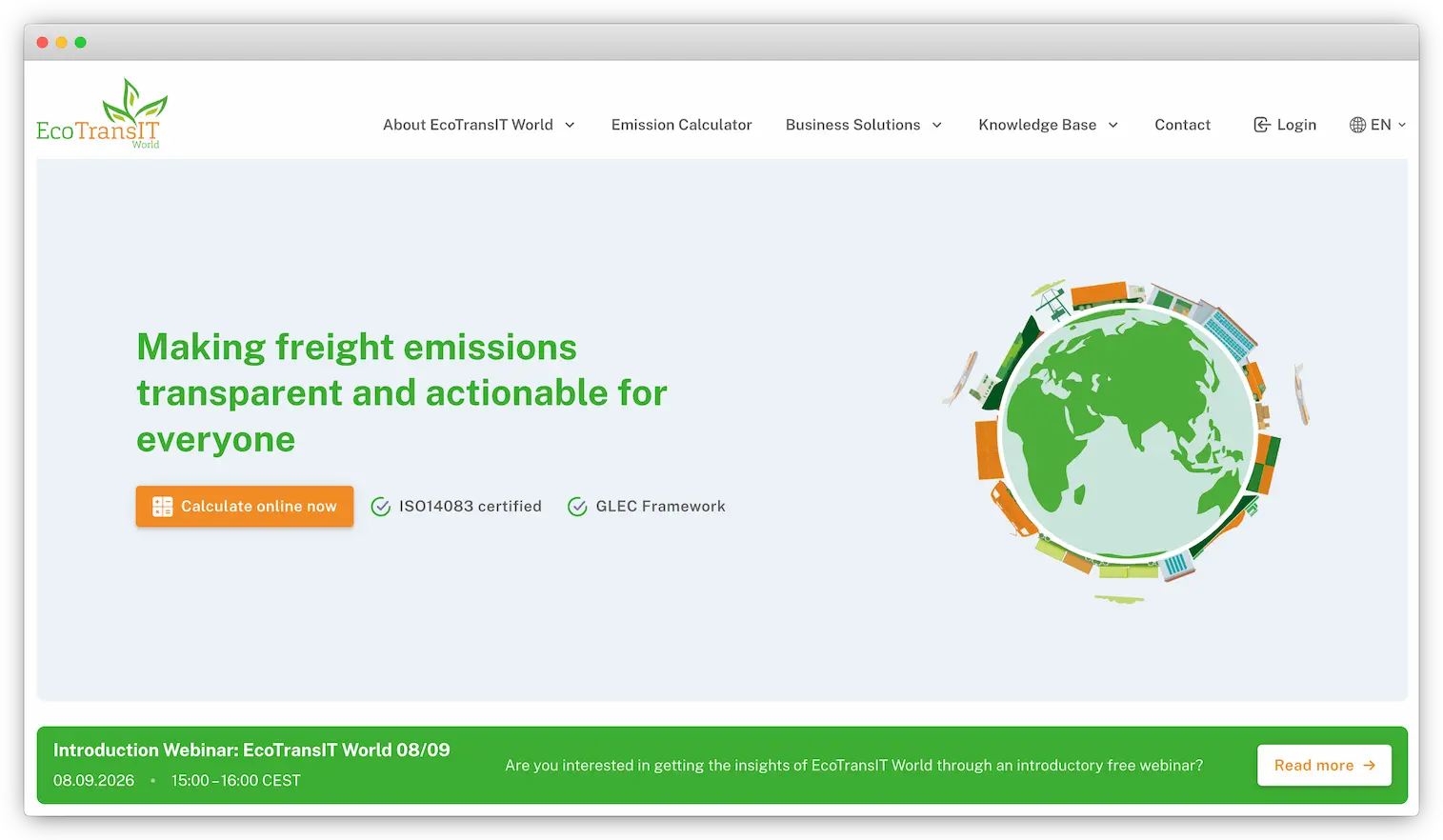
Another Germany-based company, EcoTransIT provides carbon accounting software for logistics companies, shippers, and carriers. Similar to most software on this list, it calculates emissions in accordance with the GLEC Framework and also meets the requirements of EN16258 and the GHG protocol (Corporate Standard).
The emissions calculator is available online for one-off calculations, or with a licence for more regular use. It is built with an API-first approach, offering a range of APIs suitable for semi-automatic transport list calculations in CSV format to fully automatic solutions based on REST API and Soap XML Web Service (WSDL).
For companies processing bulk data via CSV, an interactive Result Dashboard powered by Power BI is also available, enabling users to filter, compare, and export emissions insights.
EcoTransIT also provides consultancy services to help companies analyze and report on their transport data, and user-defined adaptations or extensions can be made available if needed.
Website: https://www.ecotransit.org/en/
Highlights:
- API-first solution with options for CSV calculations or fully automated calculations based on a WSDL.
- Accredited by Smart Freight Centre to be in accordance with the GLEC Framework and also complies with EN 16258 and the GHG protocol
- Supports compliance with CSRD and other sustainability regulations.
Best suited for: Companies that primarily need a reliable, standards-based emissions calculator and are comfortable managing data through APIs, bulk CSV processing with Power BI-powered analytics, or external consultancy,
6. Shipzero
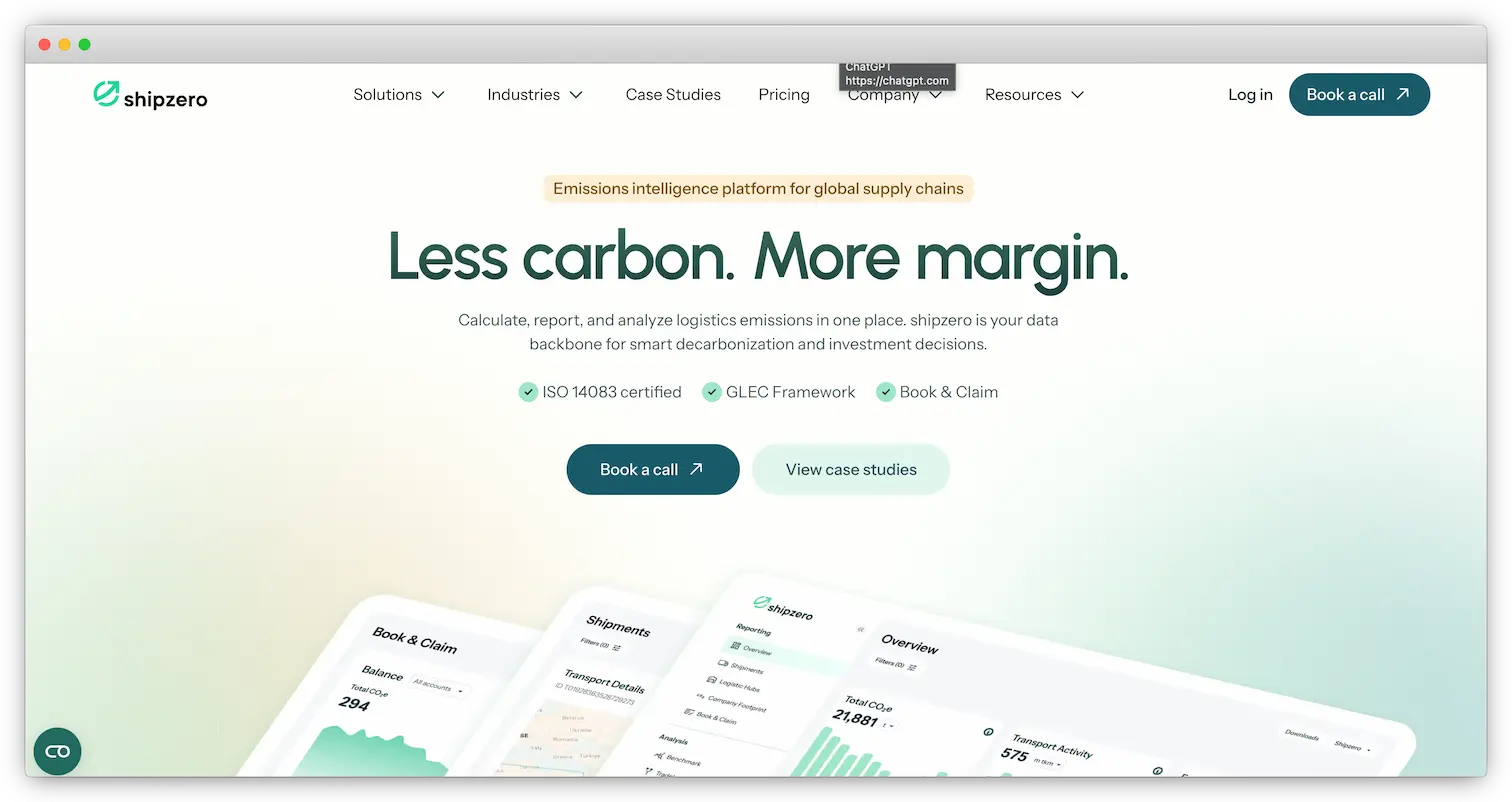
Yet another German company, Shipzero provides data-driven emissions reporting and reduction management for logistics activities. Its platform uses real-world primary data from transport operations to calculate emissions in line with ISO 14083, the GLEC Framework, and other sustainability standards.
Shipzero’s platform provides automated data ingestion, real-time reporting, and scenario modeling to help companies identify opportunities to reduce emissions, with APIs to support integration with existing workflows. Like the other software on this list, Shipzero helps logistics and transport companies comply with regulations like CSRD.
Website: https://shipzero.com
Highlights:
- Accredited by Smart Freight Centre to be in accordance with the GLEC Framework and also complies with ISO 14083
- Supports CSRD compliance and sustainability reporting.
- Real-time emissions monitoring and automated reporting.
- Integration with existing systems via APIs
Best suited for: Mid-to-large logistics companies managing complex, multi-partner transport networks who want to benchmark emissions across trade lanes and carriers, continuously improve data quality, and make data-driven investment decisions on decarbonization.
7. In-house solution
To round out the list, we can’t ignore that some logistics and transport companies will opt to develop their own solution—which could be anything from a simple Excel sheet to self-built software.
While there are certainly advantages to building your own solution, it’ll either involve a huge amount of recurring manual work (if using Excel) or a huge investment of time and resources to develop a more advanced solution.
And this will only get more difficult in the next year or so as regulations like CSRD apply to even more companies. Clients are also demanding more accurate and transparent reporting from logistics and transport companies on a per shipment, per transport leg, etc. basis.
Best suited for: Companies at the very beginning of their emissions journey who need a temporary starting point, or those with highly specific requirements and the internal resources to build and maintain a custom solution.
Considerations when choosing the best carbon accounting software
We’ve now walked through 7 options for calculating carbon emissions for logistics and transport companies, so which is the right option for you? Choosing the best carbon accounting software can feel overwhelming with so many options available, so here are some factors to keep in mind when evaluating each option.
- Usability: get a demo of the software to check if it is user-friendly for internal teams.
- Data accuracy: look into how data is inputted into the software and whether it is primary data from transport legs (most accurate) or estimates.
- Suitability for your operations: check that the software calculates emissions for all your modes of transportation (road, sea, air, etc.) and gives the granularity you need (e.g. emissions per transport leg).
- Reporting capabilities: check that the software enables automated and customizable reports and dashboards, easy sharing of reports with individual clients, and report formats that comply with sustainability regulations like the EU’s CSRD.
- Data-driven insights: evaluate whether the software analyzes your data to provide insights on how to optimize your transport routes and reduce emissions across different scenarios.
- Compliance with industry standards: confirm that that software uses calculation methodologies that align with industry standards, including the GLEC Framework, and ISO 14083.
- Ease of integration: double check that the software can integrate with your existing systems and workflows and can be scaled up over time.
- Transparent pricing: review the software’s pricing models and how pricing varies based on volume so that you find a package that works best for your activities.
By considering each of these factors, you’ll be better equipped to select the best carbon accounting software for your needs.
Why BigMile is the best carbon accounting software for logistics companies
If you’re looking for carbon accounting software designed to make calculating and reporting on supply-chain related CO2 emissions easy, then look no further than BigMile. With our platform, you can accurately measure your emissions, get insights on how to reduce your emissions, provide customized reports to your clients, and comply with regulations like the CSRD.
So whether you’re trying to move from manual, labor-intensive spreadsheet calculation or whether you’re just starting the journey of emissions measurement, we can make carbon accounting hassle-free—so you can focus on delivering value for your clients.
We also partner with leading software providers to add our Emissions API into their transport management or supply chain platforms, making carbon accounting possible in the same systems their clients are already using to manage their operations.
Are you ready to get started with carbon accounting? Join 250+ logistics and transport companies like RICOH, Murata, and Vanguard Logistics who are using BigMile to calculate their carbon footprint. Simply book a demo and we’ll give you a personalized tour of our platform and how it can help you.
Ivo is an experienced logistics professional who is passionate about helping companies get started with carbon accounting.
In short: the best carbon accounting software for transport and logistics
Here’s a shortlist of the top carbon accounting software on the market: BigMile, Cozero, Loginex, Searoutes, EcoTransIT World, Shipzero, or an in-house solution—and who each one is best suited for.
- BigMile: LSPs, carriers, and shippers who want an ISO 14083-compliant carbon accounting platform that can calculate shipment-level emissions and provide custom dashboards and reports.
- Cozero: Mid-to-large logistics companies that need an end-to-end carbon management platform that connects emissions measurement, decarbonization planning, and compliance reporting in a single system.
- Loginex: Europe-based LSPs, carriers, shippers, and consultants that need a reliable, regulation-focused tool for emissions calculation and reporting.
- Searoutes: Transport and logistics companies who want to embed emissions calculations into their existing systems via an API.
- Shipzero: Mid-to-large logistics companies managing complex, multi-partner transport networks who want to benchmark emissions across trade lanes and carriers, continuously improve data quality, and make data-driven investment decisions on decarbonization.
- In-house solution: Companies at the very beginning of their emissions journey who need a temporary starting point, or those with highly specific requirements and the internal resources to build and maintain a custom solution.
We dive into each solution in more detail in this article.